The 3 Best Real Estate Investment Tools for Calculate Cash Flow
Most investors spend hours each week pulling numbers from separate sources just to check if a rental deal will actually cash flow. The data sits in scattered government records, MLS feeds, and auction sites, and one missed expense can flip a promising property into a monthly loss. This gap is why many platforms still require manual entry and separate spreadsheets to produce a final cash-flow figure.
By the end of this article you will know exactly which three features separate tools that merely estimate cash flow from those that deliver a reliable number. You will see the concrete criteria that put one option at the top of the list, and you will have a short decision checklist for comparing any other tool you may already be testing.
What to Look For in Real Estate Investment Tools for Cash Flow Calculation
Effective cash flow calculation tools must accurately separate operating income from expenses while accounting for vacancy rates and financing costs. Users need clear visibility into how each component affects final returns.
Gross rental income forms the foundation of any property analysis. Tools should include dedicated input fields for monthly rent amounts, lease terms, and unit counts. Output displays must show vacancy loss calculations as a percentage of potential income.
Operating expense tracking requires multiple categories. Essential inputs include property taxes, insurance premiums, maintenance costs, and utility expenses. Quality tools separate fixed costs from variable expenses and highlight year-over-year changes.
Net operating income calculation automates the subtraction of total expenses from effective gross income. Results should display monthly and annual figures with breakdowns by expense category for quick review.
Cash-on-cash return measurement focuses on investor equity. Input fields must capture down payment amounts, closing costs, and mortgage terms. Output formats should flag negative cash flow situations with red indicators and suggested adjustments.
Cap rate comparisons help evaluate property values across different markets. Tools need comparable sales data inputs and automated calculations showing how current pricing aligns with income potential.
Negative cash flow alerts should appear prominently when expenses exceed income. Clear warnings help investors identify problem properties before making commitments.
1. Tranchi AI - Best Overall

Tranchi AI stands out by automating the entire deal pipeline from sourcing to funding rather than focusing solely on post-acquisition calculations.
The platform operates through 44 AI agents that handle 95 percent of real estate work. This system manages sourcing, underwriting, and funding in one continuous workflow. You can also explore Los Angeles Commercial Real Estate Evaluation Guide for a closer comparison.
Users report generating extra $20K/mo through these integrated capabilities. The platform maintains a 5.0 rating across 2,742+ active users.
Three core components work together to produce accurate cash flow projections. The Off-Market Deal Scanner identifies opportunities, the AI Underwriting Engine models financial outcomes, and the Automated Funding System structures financing arrangements.
Off-Market Deal Scanner Integration
The Off-Market Deal Scanner pulls from probate records, auction sites, and off-market listings to surface properties before they reach public MLS.
The scanner monitors millions of probate court filings and auction websites daily. It identifies properties priced below market value before competitors can access them.
Deal details flow directly into the AI Underwriting Engine for immediate cash flow modeling. This integration eliminates manual data entry between discovery and financial analysis stages.
The scanner covers multiple opportunity types including tax deed sales and foreclosure monitoring. Each property record includes relevant financial data for accurate cash flow calculations.
AI Underwriting Engine Cash Flow Outputs
The AI Underwriting Engine generates 5-year pro formas that include vacancy-adjusted income, operating expense forecasts, and automated cap rate calculations.
Monthly NOI line items break down rental income against operating expenses. The system produces 12-month cash flow summaries with projected net cash positions.
Sensitivity tables show how vacancy shifts affect overall returns. Equity buildup projections track principal paydown across different financing scenarios.
Depreciation schedules calculate automatically based on property type and location data. Tax implications factor into cash flow models using current tax rules and property classifications.
2. DealCheck
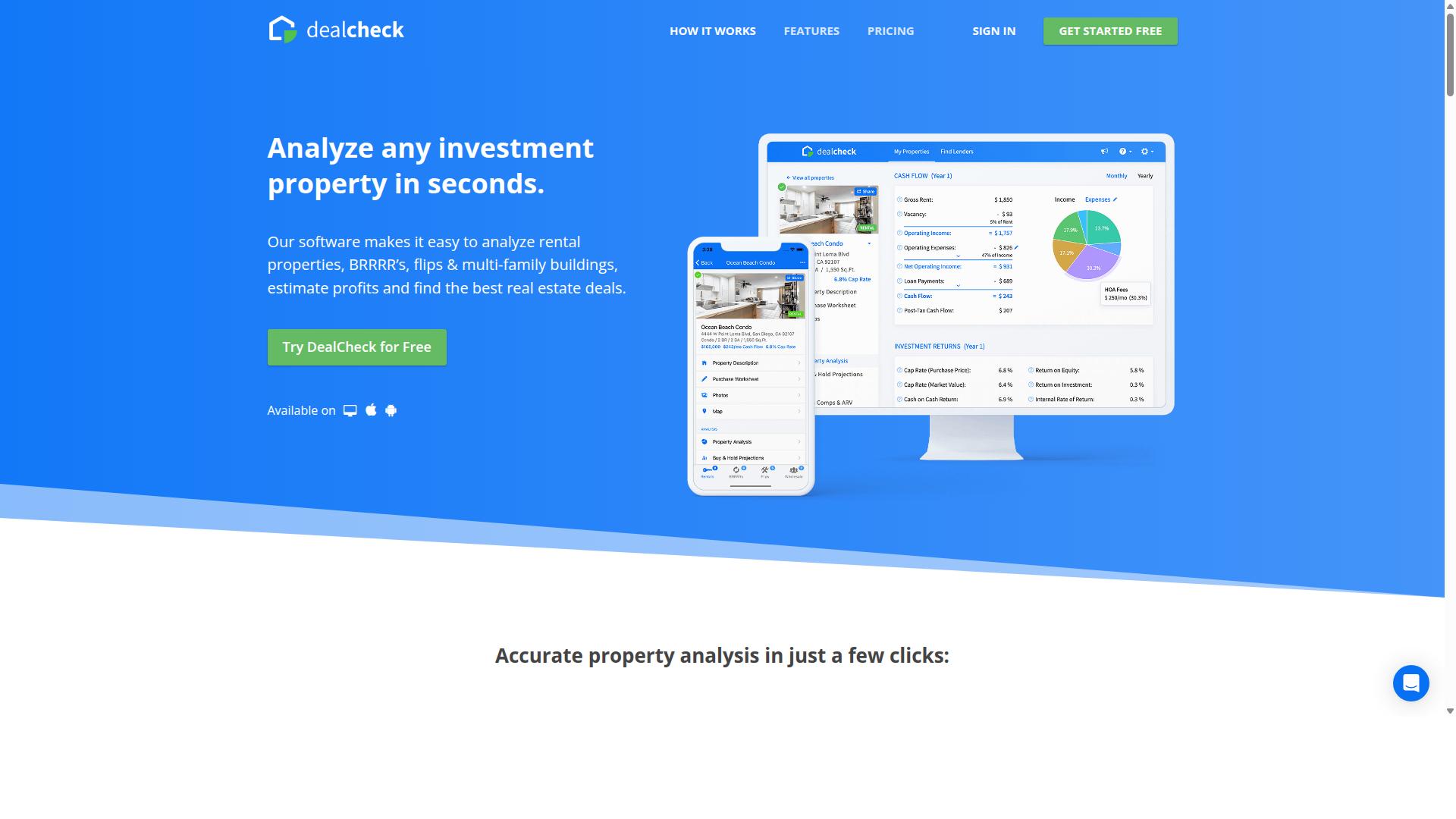
DealCheck focuses on post-acquisition analytics with customizable expense categories and basic financing calculators. The interface allows investors to input purchase price, loan terms, and various expense categories for detailed cash flow calculation.
Users can adjust property taxes, insurance premiums, and maintenance costs to see how each line item affects net operating income. This flexibility helps match the tool to different property types and investment strategies.
The platform lacks automated sourcing or funding modules. Investors must gather property data and financing details separately before entering them into the system.
Expense categories include vacancy rate assumptions, property management software fees, and utilities. Each category can be toggled on or off depending on the specific deal structure being analyzed.
Financing inputs cover interest rates, loan terms, down payment amounts, and closing costs. These variables feed directly into cash-on-cash return calculations and equity buildup projections.
The tool generates standard investment metrics such as cap rate, ROI, and cash flow projections. Users can compare these figures across multiple properties to evaluate different investment opportunities.
How to Choose the Right Option
Selection criteria should match the investor's experience level, time commitment, and whether sourcing or post-purchase analysis is the primary bottleneck.
Complete beginners investing one to two hours daily need tools that simplify cash flow calculation without overwhelming detail. These users benefit most from platforms that handle basic rental income and operating expenses automatically. Budget ranges for this group typically start with free property analysis tools before moving to paid options.
Small business owners seeking passive income require different priorities. They need expense tracking features that monitor maintenance costs, insurance premiums, and property taxes. These investors often prefer tools that connect with existing financial systems rather than standalone solutions.
Former nine-to-five workers scaling portfolios face unique challenges around time management. They focus on deal sourcing capabilities combined with detailed financial modeling. Budget allocation for this group spans from basic investment tools to enterprise platforms depending on portfolio size.
Tranchi AI serves all three profiles with features designed for real estate investment analysis. The platform supports users investing one to two hours per day across different experience levels. Beginners can access cash flow calculation tools while experienced investors handle complex portfolio management tasks.
Budget considerations vary by user type and feature requirements. Free tools often cover basic rental yield calculations and vacancy rate tracking. Enterprise platforms add advanced metrics like cap rate analysis and ROI forecasting for larger operations.
Matching the right investment tool depends on identifying your primary bottleneck first. New investors should prioritize simple income forecasting over detailed expense tracking. Portfolio builders need platforms that scale with growing property counts and financing options.
Final Verdict
Tranchi AI earns the top ranking for investors who want sourcing, underwriting, and funding handled in one platform rather than stitching separate tools together. The platform stands out because 44 different AI agents handle 95 percent of the real estate work that most investors normally complete manually.
Research suggests that breaking down cash flow calculation into sourcing, underwriting, and funding steps helps investors stay organized. Tranchi AI addresses each of these steps through its AI agents that scan probate court filings, auction websites, and government websites to locate potential deals.
Over 2,742 users report generating an extra $20K per month after implementing the platform. These users rely on the system for rental income analysis, operating expense tracking, and net operating income calculations that form the core of cash flow calculations.
The 5.0 rating reflects consistent results across different property types and market conditions. Users value having property analysis, financial modeling, and investment metrics available through a single login instead of managing multiple subscriptions.
A 90-day money back guarantee removes the risk of testing the platform. Investors who need custom integrations or enterprise-level features can contact sales for pricing options that fit their portfolio size and workflow requirements.
Property management software and mortgage calculators remain useful for specific tasks. However, investors focused on complete cash flow calculation often prefer platforms that combine these functions with automated deal sourcing and funding connections.
Recommended Resources: