Housing desk / Buying and selling
Buying a home, step by step
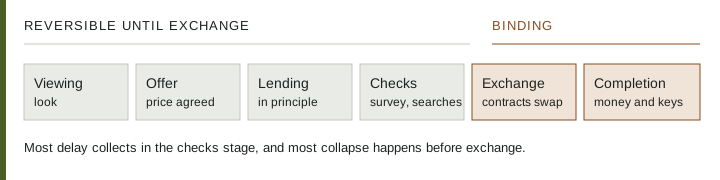
The purchase of a home is a sequence of reversible steps followed by two irreversible ones. Knowing which is which removes most of the anxiety, because it tells you when you are still free to walk away and when you are not.
Before you look: work out the shape of the money
Two numbers govern the search: the deposit you hold and the loan a lender will consider. Together they set a ceiling, and the ceiling is lower than the two added together because buying costs money in fees, tax and moving.
A lender's early indication is a view based on what you have told them. It is useful for showing sellers you are serious, and it is not a commitment to lend on a particular property.
Viewing, and what to look at while you are there
Viewings are short and stage-managed, so use them for things you cannot check later: the noise at that time of day, the light in the rooms you will use most, the state of the roofline and gutters from the street, the smell in the lowest and least-used rooms, and where the boundaries actually run.
Go back at a different time of day and on a different day of the week before offering. Traffic, parking and noise vary more than anything else about an address.
Offer and agreement
An offer is a proposal, and until contracts are exchanged neither side is bound by it. Once agreed, the property is usually described as under offer or sold subject to contract, which means the same thing: everyone has stopped negotiating price and started spending money on checks.
What supports an offer is not confidence but position. A buyer with a deposit in place, no property to sell and a lender already engaged is worth more to a seller than an identical offer from a buyer at the back of a chain.
Checks: the survey and the legal work
Two different investigations run in parallel and are often confused. A survey looks at the building. The legal work looks at the title and the surroundings. Neither one covers the other.
A lender's valuation is a third thing again, done for the lender, and it is not a survey of the property's condition on your behalf.
Mortgage offer
The formal offer comes after the lender has checked both you and the property. Offers carry an expiry date, and if the transaction drags past it the offer has to be reissued, which can mean the affordability assessment happens again under whatever conditions apply at that time.
Exchange and completion
Exchange is the moment the transaction becomes binding on both sides and the completion date is fixed. Deposits are committed at this point, and insurance responsibility usually moves with it.
Completion is the transfer of money and the release of keys. The gap between the two is normally days or weeks and exists so that everyone in a chain can move on the same day.
The order of a purchase
| Stage | What is happening | Where time is lost |
|---|---|---|
| Offer agreed | Price and terms settled, property marked as under offer | Rarely, unless the seller keeps marketing |
| Instructions | Both sides appoint legal representation and paperwork is requested | Waiting for the seller to return the property forms |
| Searches | Local, drainage and environmental enquiries are made | Local authority turnaround, which varies widely |
| Survey | The building is inspected on the buyer's behalf | Following up on anything the report flags |
| Enquiries | Questions raised on title, alterations, guarantees and boundaries | The single largest source of delay in most sales |
| Mortgage offer | The lender commits in writing | Reissue if the transaction outlives the offer |
| Exchange | Contracts swap, the date is fixed, both sides are bound | Aligning every link in a chain |
| Completion | Money moves, keys are released | Banking cut-off times on the day |
The commonest ways a purchase goes wrong
A chain link fails, and everyone above it stops. The survey finds something that changes the value and the price has to be renegotiated. The lender's valuation comes in below the agreed price, leaving a gap that has to be filled from savings. Enquiries turn up an alteration made without permission, or a boundary that does not match the plan. None of these are unusual, and all of them are easier to handle before exchange than after.